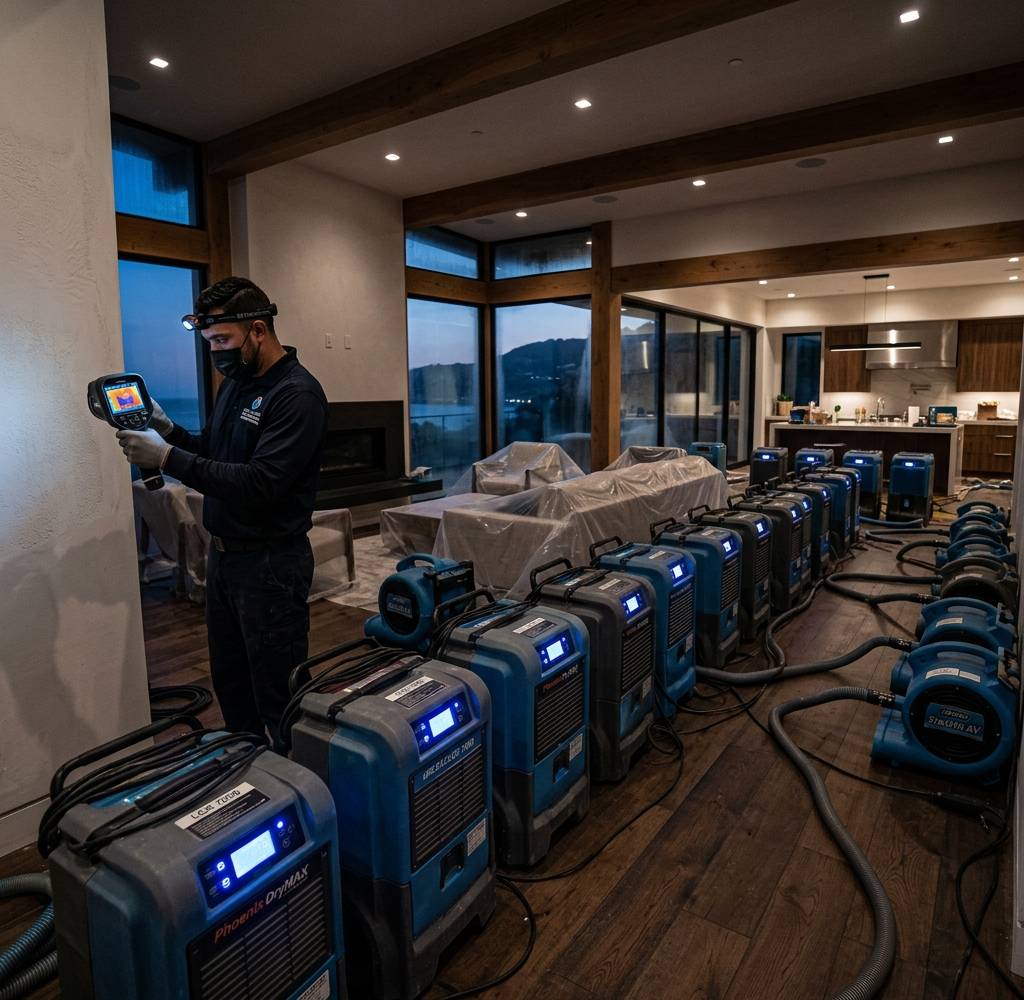
Structural Drying Science in Malibu
Talk to a local crew now. Most jobs start the same day you call.
- Water extraction & pump-out
- Structural drying & monitoring
- Mold-safe cleanup
- Insurance-ready photo reports
Coastal estates often feature non-standard structural elements — pier foundations, cantilevered subfloors, and custom plaster finishes. Drying these complex assemblies requires detailed psychrometric mapping and positive-pressure drying systems, not generic demolition.
What Our Structural Drying Science Includes
We dry in-place to protect plaster, custom wood assemblies, and high-value architectural details.
Non-Invasive In-Place Drying Systems
Generic contractors often cut out wet drywall and tear up saturated hardwood floors because it is simpler. In coastal properties, custom redwood panels, reclaimed barnwood floorboards, or hand-painted plaster ceilings can be hard to replace. We use psychrometric drying principles to save these materials whenever possible.
- Direct Heat Drying (TES/Injectidry): We inject targeted, super-dry heated air into wall cavities, subfloors, and wood structures, vaporizing moisture.
- Rescue Mat Subfloor Systems: Sealed extraction pads that pull standing moisture straight through the tongue-and-groove pores of hardwood floors.
- Vapor Pressure Balancing: We manipulate target indoor relative humidity to force moisture from deep wood studs into the air.
- Dry Clearance Logs: Daily moisture readings taken at the same structural points to track progress toward drying targets.
Advanced drying gear includes Injectidry wall cavity systems, TES (Thermal Energy System) heaters, high-grain LGR dehumidifiers, Rescue hardwood floor mats, and psychrometric mobile tracking apps.
Why Standard Inland Drying Protocols Fail in Malibu
Inland contractors often do not account for Malibu’s coastal baseline microclimates, which can lead to failed dryouts.
Standard restoration templates assume an ambient outdoor relative humidity of 30% to 40%. In Malibu, beachfront properties and canyon bottoms face consistent marine layers with humidity levels pushing 85%+. Standard equipment layouts cannot overcome this external moisture load. Wet timber inside a beachfront home responds differently than structural wood in inland Pasadena.
To dry a home on Broad Beach or Carbon Beach, we establish tight vapor barriers, sealing the affected zones from the coastal marine air. We then deploy higher capacity LGR dehumidifiers and positive-pressure heaters. This creates an artificial dry climate inside the structural envelope, forcing deep moisture out of thick Douglas fir or cedar structural framing.
Psychrometric Dry Clearance Report
Once structural drying is complete, you receive a psychrometric chart printout and moisture clearance readings. This documents that structural components (subfloor, drywall framing, ceiling joists) have returned to safe, natural wood moisture levels. This documentation can help with your home’s resale value and with verifying dry status for your insurer.
In-Place Drying Reduces Claim Friction
Specialty insurers often prefer in-place structural drying because it preserves materials and architectural details. By using non-destructive drying systems, we look to limit demolition, keep reconstruction timelines shorter, and allow you to stay in your home.
Frequently Asked Structural Drying Questions
What is psychrometric science in restoration?
Psychrometrics is the thermodynamic science of air, water vapor, and moisture levels inside structural materials. We monitor the temperature, relative humidity, and dew point of the air to maximize vapor pressure, pulling moisture out of deep wood elements.
Can you dry hardwood floors without tearing them up?
Yes. By using vacuum-sealed Rescue Mats, we draw moisture directly out of the wood floor’s pores. In many fresh-water pipe leaks, we can dry and save oak, walnut, or pine hardwood floors without tear-out.
What happens if a wet subfloor is left to dry naturally?
It won’t. Malibu’s high coastal humidity prevents deep plywood or framing from air-drying on its own. The wood can cup, warp, lose structural integrity, and allow mold to grow inside the floor cavities.
How do you know when a structure is completely dry?
We take daily moisture readings using deep-penetrating pin meters and non-invasive scanning meters at established checkpoints. We compare these readings against dry standards taken in unaffected rooms, stopping only when standard targets are hit.
Does the structural drying process smell?
As materials dry, you may smell a faint, earthy wood aroma. We deploy high-capacity HEPA air scrubbers equipped with industrial activated charcoal filters to continuously scrub the air and neutralize odors.
Questions people ask before they call
What is psychrometric science in restoration?
Psychrometrics is the thermodynamic science of air, water vapor, and moisture levels inside structural materials. We monitor the temperature, relative humidity, and dew point of the air to maximize vapor pressure, pulling moisture out of deep wood elements.
Can you dry hardwood floors without tearing them up?
Yes. By using vacuum-sealed Rescue Mats, we draw moisture directly out of the wood floor's pores. In many fresh-water pipe leaks, we can dry and save oak, walnut, or pine hardwood floors without tear-out.
What happens if a wet subfloor is left to dry naturally?
It won't. Malibu's high coastal humidity prevents deep plywood or framing from air-drying on its own. The wood can cup, warp, lose structural integrity, and allow mold to grow inside the floor cavities.
How do you know when a structure is completely dry?
We take daily moisture readings using deep-penetrating pin meters and non-invasive scanning meters at established checkpoints. We compare these readings against dry standards taken in unaffected rooms, stopping only when standard targets are hit.
Does the structural drying process smell?
As materials dry, you may smell a faint, earthy wood aroma. We deploy high-capacity HEPA air scrubbers equipped with industrial activated charcoal filters to continuously scrub the air and neutralize odors.
Every hour water sits, damage spreads.
Drywall wicks, floors cup and mold can start within a day or two. Call now.